Saturday, 28 November 2015

Name Bunting

The autumn is always busy at ElleAyJay Towers, not least because I suddenly realise how many birthday and Christmas presents there are to make and how little time I have. This year is no exception, not helped by also trying to give the bathroom a revamp.

My very good friend has two little boys and, as each arrived, I made them bunting that spelled out their name. In each case, the end product was very well received and so I decided that 'Mum' should get to have her name in bunting too. So, with her birthday rapidly approaching I finally sat down to the project, managing to sew each letter between spraying coats of paint on the bathroom towel rail.

I have no idea what the individual elements on a string of bunting are officially called but here I'm going to call them 'flags'. In this version, each flag is made from two pieces of fabric, each measuring 12cm by 9cm. You will need a pair of fabric rectangles for each letter, preferably a plain fabric; and a pair for each end, preferably a patterned fabric.


For the letters I used the computer, dividing an A4 sheet into quarters and typed out my friend's name with one letter in each quarter of the page, adjusting the size of the letters until it looked about right. Once printed out I traced the letters back-to-front onto some bondaweb and then cut each letter out roughly.


These were then ironed onto felt before being cut out following the traced lines of each letter.


I carefully peeled the paper backing from each bondawebed letter and lined each letter onto a piece of the cut plain fabric flags.  Each letter was set slightly lower than centre since I knew I was going to lose a bit of the top when I sewed it onto the ribbon.


The next bit is rather a of a labour of love and what occupied me between coats of radiator paint. If you've seen a previous post featuring an appliquéd blanket, you may know I have a bit of a soft spot for blanket stitch. Bondaweb is a great invention but the heat-activated glue can fail over time so adding something more permanent is always recommended. In this case I chose to use tiny blanket stitches using embroidery thread. Well, if I'm honest, I did this for my friend's first son and felt I had to continue the theme for fear of causing sibling rivalry! Anyway, depending on the complexity of the letter this took me between 30 and 45 minutes per letter. However, since this blog is all about the hand made as opposed to the mass-produced, as well as the joy of creating something by hand, it's all part of the process and it was really rather relaxing (not to mention better than watching radiator paint dry!).


Once all the letters were stitched securely in place, I turned my attention to making each flag by placing each piece of fabric with a letter on it, face to face with a correspondingly coloured but unadorned piece of fabric. I did the same with each pair of pattered pieces of fabric. Using the sewing machine I then sewed around the sides and bottom of each flag leaving as small a seam as I could - about 0.5cm.


I clipped the bottom corners and then turned each flag the right way out, ensuring the corners were as sharp as possible, before pressing flat.


The final step was to sew the flags (in the right order!) onto some bias binding. I first pressed the bias binding in half lengthways and then spaced the flags out before pinning them in place.


A line of stitching the full length of the bias binding was all that was left to do before I could admire my day's work.


Now all I have to do is apply the final coat of paint to the radiator!

Monday, 23 November 2015

You don't mind when it's something you enjoy

On Saturday morning I went to a craft fair held at my parents' local garden centre. There were about 40 stalls of local producers ranging from ceramics and jewellery through to a producer of beauty products made from lavender grown in the Mendips, a Somerset cider maker, and even a local vineyard showcasing their first commercial wine (a delicious rosé).

One stall holder made the most intricate beaded jewellery. It wasn't quite to my taste but I could fully appreciate the enormous amount of time that she must spend on her craft, the smallest of which must contain hundreds of beads, and I said as much. The lady did agree but added 'but you don't mind when it's something you enjoy, do you'.

She couldn't be more right in my opinion and I instantly thought of the project that I've been working on for the past six weeks - or is it seven?  Or perhaps it's only four but feels like it has been going on forever (I'm not the most patient of people!) The project is making a set of coasters and placemats for my new dining table. The table was purchased in early October and was finally delivered last week. It will seat 8 cosily so I had begun work on a set of eight placemats and coasters as soon as I had ordered the table, having been thinking about them for some time before.

I had originally thought of making the coasters from denim but my fabric searches had failed to unearth anything that was the right colour or wasn't so rigid that I feared for my sewing machine and the quality of the final product. Alongside my fabric searching I seemed to keep running into conversations or magazine articles or things in shops about needle-felting - a craft that I haven't done for some time. I decided the coincidences of these encounters and the lack of suitable denim was trying to tell me something and so I decided the placemats and coasters should all be needle-felted. The end product would be thick enough to offer great heat resistance and the materials required were either already in the house or easy to find from local craft suppliers

A new kitchen is also being planned - black and white with hints of oak - so I thought I could get rather bold with accessories, including the placemats. I therefore hit on a 'rainbow' theme, making each mat a different colour. I had 5 of the 8 colours already in stock so the financial outlay for the additional colours was minimal (about £3 per colour) plus a 30cm diameter tapestry ring to use as a template for the placemats (also only about £3). What I had forgotten was how long needle-felting takes, particularly large items! What I would save in fabric costs would be made up for in woman-hours. However, as the bead jewellery lady so rightly said yesterday, you don't really mind when it's something you enjoy. I'm also getting to catch up on a lot of radio dramas (bliss!)

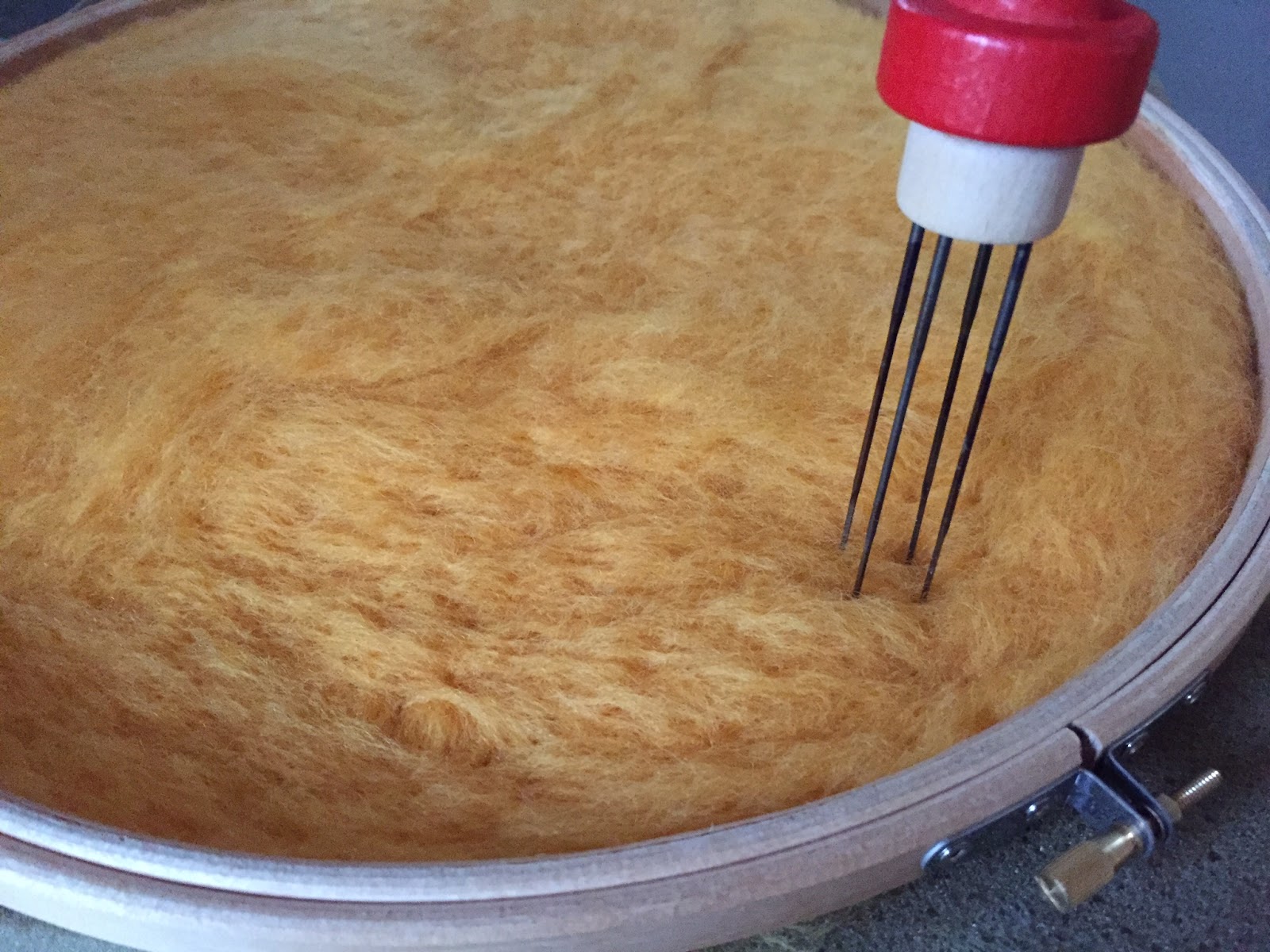
So, in amongst the 9-5 job, household chores and errands, even attempting to maintain some sort of social life and not become a wool-stabbing recluse, I have spent the past 6 weeks attempting to turn this...
...to this...


If you are unfamiliar with the process of needle-felting it essentially involves stabbing carded wool with small barbed needle (or four together in a holder as pictured). You need a foam pad to work on that the needle can sink into; and, in the case of the placemats and coasters, some sort of circular template such as a tapestry frame (the placemat) or a cookie cutter (the coaster).  The stages look something like this...

Lay tufts of the carded yarn criss-cross within the template

Stab with your needles

Turn and stab some more

Keep going until the surface is dense and neat

I find that I need to peel the felt off the foam pad and turn it over and needle it from the other side about 4 or 5 times, hence it takes so long to make.

I've only managed to make 6 placemats and 5 coasters so far, but with the added arrival of new dining chairs on Saturday, I couldn't resist testing out the overall look.


Spot the missing coaster!
Now I just have to make the final placemats and coasters. The two missing colours are royal blue and purple.

I'm really pleased with the look so far, the mats giving a real pop of colour to the room. However, I fear they are not very festive so I may need to come up with an alternative for the Christmas table. I'd better get my thinking cap on!

Monday, 2 November 2015

Halloween Food Fun

I'm busy making some placemats and coasters but it's turning out to be a lengthy process at a busy time of year. As a result, I'm only about half-way through and am not yet ready to share. However, I took time out from placemat-making this weekend to have some Halloween fun with food.

As a regular reader of the Sainsbury's Magazine I had spotted a tasty-looking themed menu in the October issue so promptly invited some friends over and got cooking.

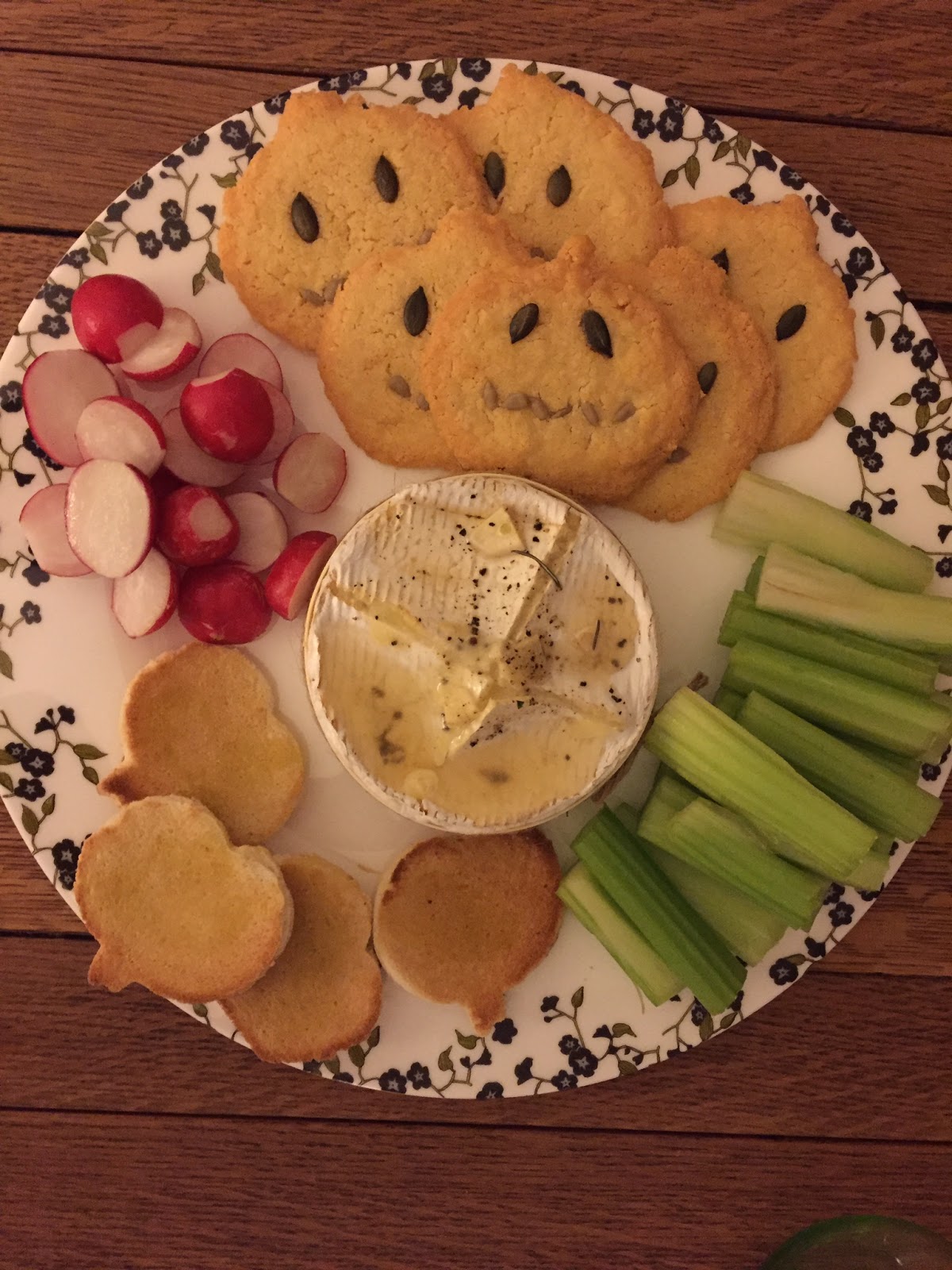
The menu consisted of baked Camembert with pumpkin dippers and crudités, followed by smoky chipotle chicken one-pot with chunky coriander guacamole, with a spiced treacle and hazelnut tart for dessert.

I had to make a few tweaks in order to cater for everyone but I can't say they had any effect on everyone's enjoyment of the meal.

Firstly I had to make it all gluten-free, which is my excuse for the pumpkin dippers spreading out rather more than expected - still deliciously cheesy and fun, if a little thin and losing their shape!


I then had to substitute the coriander, since it is a pet hate of one of my friends. I chose parsley instead.

As for the treacle tart, as well as being gluten-free it turned out a whole lot more ghostly.  I couldn't lay my hands on the recommended bat cookie cutter for the decorations but think the ghosts look just as fun floating around in the treacle.


OK, so I'm not likely to be picked to take part in the next Great British Bake Off as a result of my efforts (not least because I don't get the impression that the judges do gluten-free very willingly!) However, in my defence, the tart didn't have a soggy bottom and, in spite of some shrinkage at the sides and a little bit of a spillage of the filling, it tasted delicious and my friends were sent home (willingly!) with a doggy bag of treacle tart.

Huge thanks to my friends for being my guinea-pigs and indulging me in my food fun. And, now that it's tried and tested, I'm busy working out what cookie cutters I can use for the same menu on Christmas Eve!

Saturday, 10 October 2015

Autumnal Italian Chestnut Cheesecake

This week I'm staying with friends in their farmhouse innorthern Tuscany so this is most definitely the Italian edition of ElleAyJay.

Shortly after I arrived my attention was drawn to a magazine sitting on the kitchen table. It looked like the sort of magazine that is produced to celebrate a region's cuisine. My knowledge of Italian is non-existent so I was making my judgement based purely on appearances. The production values appeared high with mouth-wateringly beautiful photos of food and a stylish layout.

I was, therefore, somewhat surprised to learn that it was the seasonal magazine produced for loyalty card holders of a supermarket chain, Esselunga. Anyway, it was just packed full of delicious looking autumnal recipes and the cheesecake on the cover had certainly grabbed my attention.


Having found the recipe inside, I enlisted the help of my friends' knowledge of the Italian language alongside a healthy use of the internet to discover it was a Chestnut Cheesecake. Since my friends live on the side of a valley covered in chestnut trees I felt that it would be a bit of a crime not to attempt to make it. Also, if it turned out to taste as good as it looked, taking the recipe home could be one of the best holiday souvenirs ever.

Inspiring chestnut trees (and amazing view)

More testing of my friends' knowledge of the Italian language against my knowledge of making other cheesecakes made me feel fairly confident that I could attempt to make it. It therefore just remained to see if we could find all the necessary ingredients. We naturally headed to the aforementioned local supermarket.

So, here is my version of Autumnal Italian Chestnut Cheesecake.

Take a 20cm diameter spring form or loose bottomed cake tin and line with baking paper.

Melt 100g butter and mix in 180g finely crushed biscuits such as digestives (gluten-free or ordinary) and 75g finely chopped Marrons Glaces. Actually Marrons Glaces were the one ingredient the supermarket couldn't sell us so we improvised. Last year my friends gathered, cooked and painstakingly peeled a pile of chestnuts from their land and made chestnut liqueur. We therefore purloined all the chestnuts for this recipe from their sweet, boozy bath as a delicious substitute. Anyway, press your butter, biscuit and chestnut mixture into the base of the tin. Chill in the fridge whilst you prepare the fillings.

Firstly chop another 75g Marrons Glaces and set to one side. Next, place 10g leaf gelatine in a bowl of cold water and leave to soak for 10 minutes.

The next ingredient required literally translates as 'spoonable cheese' but in England this is cream cheese of the spreadable variety, such as Philadelphia. Take 250g of the cream cheese and beat with 240g 'creama di marroni'. This was sold in the jam section of the supermarket so I can only assume it's chestnut jam (or chestnut spread?) since the ingredients listed are chestnuts, sugar, pectin and vanilla essence.


Assuming you can't get hold of this in the UK, I suggest using the same quantity of sweetened chestnut puree and a heaped tablespoon of vanilla bean paste. Chestnut puree tends to have a pretty solid consistency so this may take quite a bit of mixing. Once fully blended, set the mixture to one side. If you've used chestnut puree you may need to make a judgement call on the consistency of this filling. If it looks too loose to hold its shape you may need to add some gelatin. In this case, soak some more gelatine (say another 5-10g) as described above.  You will eventually split this across the two fillings.

Next, take 250ml cream and gently heat 5 tablespoons of it in a small saucepan but do not let it boil. Remove from the heat. Whisk the rest of the cream with 10g caster sugar until it forms soft peaks.

Gently lift and squeeze the soaked gelatine from the cold water and dissolve in the warmed cream. If you have just used 10g of gelatine, whisk all of it into the cream and sugar mixture and quickly fold in the chestnuts you chopped earlier. If you decided your cream cheese mixture needed thickening and added more gelatine, just add half to the whipped cream mixture at this stage.

Pour the whipped cream and chopped chestnut mixture onto the chilled biscuit base and smooth to form an even layer. You will need to work fairly fast as the gelatine will begin to set as it cools, which it will do as it mixes with the cold whipped cream.

Next, add the remaining gelatine and warm cream mixture (if using) to the cream cheese and chestnut puree mixture and stir very well. Add this final mixture to the tin to form a second layer of filling. Spread this evenly over the cream layer, making the top as smooth as possible. Chill the cheesecake for at least 6 hours.


To serve, remove from the tin to a serving plate and decorate with 10 whole Marrons Glaces, one per slice.


I can confidently report that the finished product lived up to expectations and it may well be making an appearance around the festive table this Christmas!

Saturday, 26 September 2015

Roast Tomato Sauce

This week saw the first day of autumn, or the autumn equinox, and the traditional season for a 'harvest festival'. I therefore shouldn't be surprised that in recent weeks my focus has been on cooking up what nature (with a little help from me in some cases) has produced.

This week is no exception. I have heard that this year in the UK has been a poor year for tomatoes but a great year for figs. I beg to differ. My fig tree has produced only around 6 ripened fruit so far but my tomatoes have been brilliant. Hardly a split fruit and I'm confident that a record percentage will ripen, meaning I probably won't be making any green tomato chutney this year - a definite first.

However, this did mean that I found myself picking 2kg of ripe tomatoes in one go - probably another record. I decided to roast them to make a sauce.


I set the oven to heat up to 190C, gas mark 5, and dug out two large baking trays, which I lined with a sliced onion and 5 cloves of garlic, also sliced. I then set out to halve my 2kg tomatoes and place these on the onion and garlic, cut side up. The whole lot was sprinkled with thyme leaves, salt, pepper, a teaspoon of soft brown sugar, 2 teaspoons of balsamic vinegar, and 4 tablespoons of groundnut oil.


I placed them in the oven for 70 minutes, switching the trays around half-way through the cooking time.


After allowing the trays to cool slightly I tipped everything into a food processor and gave it a blitz before pressing the puree through a sieve to remove the seeds and tomato skins.


If you prefer a chunky sauce you will need to skin the tomatoes before roasting them and then just give them a brief turn in the food processor after roasting. However, my tomatoes are a small, cherry variety and the thought of skinning them all at the start was too much to contemplate. You do lose some volume of sauce when sieving it though. I ended up with 750ml of sauce, enough to serve 6 as a pasta sauce. I imagine that a skinned and un-sieved version would give you almost a litre.

All in all, a pretty easy way to deal with a glut of tomatoes, as well as store some of the taste of summer for a cold winter day, since the sauce freezes well. I placed two 250ml batches in the freezer and kept another 250ml portion in the fridge for a speedy work-day pasta supper.

Delicious!

Saturday, 19 September 2015

Spiced Cranberry Vodka

All that talk of sloe gin last weekend got me thinking about making something 'warming' for the shorter and colder days that aren't too far around the corner.

Last winter I made a couple of dishes that called for 200g of cranberries and I could only buy them in 300g bags. Each time I put the left-over 100g into the freezer, thinking they'd come in handy. All these months later and I still have the two partially filled bags of cranberries waiting to be turned into something.

When making sloe gin the big chore is to prick each and every sloe with a pin in order to allow the gin to get into the fruit and enhance the flavour of the finished product. A simple alternative is to freeze the fruit before steeping it in the gin. The science behind this is that water expands on freezing so the water in each and every cell of the fruit expands as it freezes and bursts the cell wall. This is why defrosted fruit and vegetables are always a bit limp compared to their fresh versions as they have lost all their structure. Anyway, with all the cell walls split you have essentially done the equivalent of sticking a pin in each and every one quite a few times over.

With my cranberries already frozen they seemed ripe for dropping into a jar of alcohol and I felt vodka would be a good option. Sloe gin seems to call for up to the same volume of sugar as fruit but I find this a bit sweet. So, on this occasion I erred on the side of caution and added just 100g caster sugar to my still frozen 200g cranberries and threw these into a clip-top jar with 1 litre of vodka.


To make up for the slightly lower level of sugar I added a teaspoon of vanilla bean paste before unearthing an already open packet of mulled wine spice sachets, which I thought would add a nicely warming element. Not sure how many to put in, I threw caution to the wind and added three. This could be a huge mistake but we will have to wait and see.


I should say that I sterilised the jar first by placing it, without the rubber seal that sits around the lid, into a warm oven for about 15 minutes. Meanwhile, I popped the rubber seal in a heatproof bowl and poured over some boiling water. I let the jar cool a bit before adding the vodka and other ingredients so as not to crack the glass with the shock of the cold vodka or risk scorching the fruit and spices.

With all the ingredients in and the lid reassembled and sealed, I gave the whole lot a gentle shake.


I will give the jar a daily gentle shake until all the sugar has dissolved - you'll be able to see it settle on the bottom if it's still in granular form. I'll then switch to giving it a gentle shake on a weekly basis.

Sloe gin is generally left for up to three months but other flavoured tipples I've made have been left for just two weeks. I have no idea how long I'll leave this little concoction for but I'll let you know what I end up doing and what the results are like.

Fingers crossed it will work out well and keep the family happy and quiet over the festive season!

Monday, 14 September 2015

Deconstructed Rhubarb Crumble

I'm not sure what has got into the rhubarb plants this week but, having picked over half a kilo from my two plants last Sunday, I ended up picking another 625g this Sunday. This is definitely a personal best. However, with the days getting shorter and cooler, I imagine this could be the final crop, or at least the final crop from which anything meaningful can be created.

Yet again I was casting around for an interesting recipe and came across a label I'd saved from a bottle of sloe gin given to me a couple of Christmases ago. This 'serving suggestion' was to bake rhubarb in the gin, which sounded like a match made in heaven. So, I chopped the rhubarb into 1-2cm pieces and put them in a roasting dish. I then mixed 80g caster sugar with 7 tablespoons of sloe gin and a couple of tablespoons of water before pouring this over the rhubarb. I popped this in the oven (heated to 180C, gas mark 4) for 40 minutes until the fruit was tender, basting it every 10-15 minutes.


Wondering aloud what may be nice served with this baked rhubarb my friend suggested some nutty biscuits that my Mum had made a while back. Fortunately I have this recipe in my collection so I knocked up a batch whilst the rhubarb was baking. Helpfully, both recipes are baked at same temperature.

These are officially Almond and Pecan Biscuits but I didn't have any pecans so substituted these for pistachios. I'm sure the recipe would work well with any sort of nut.  To make these cream 150g softened unsalted butter with 100g caster sugar, then mix in 100g ground almonds, 100g gram flour, 60g chopped pecans (or other nuts of your choice), 2 teaspoons of vanilla extract (or vanilla bean paste), and 1/2 teaspoon of ground ginger. Form the mixture into 12 equal sized balls and place on two baking trays lined with non-stick parchment. Flatten the dough balls slightly before baking in the oven for about 15 minutes.

Allow to rest on the trays for a few minutes before moving to a wire rack to cool completely. If you find the oven a bit full with the rhubarb too, you can always cook the biscuits in two batches. This also saves on baking parchment as well as washing up.


The rhubarb recipe says that it's best served slightly warm, and with a very healthy lunch of salad consumed, my friend and I couldn't help but try the rhubarb with a still-slightly-warm biscuit on the side. The result was divine and resembled a somewhat deconstructed fruit crumble, particularly if you let your biscuit soak up a bit of the rhubarb 'juice'.


There will now be no stopping me deploying both recipes when I next make a rhubarb crumble. I think briefly blitzing all the biscuit recipe dry ingredients with cold butter to make a crumb texture and using this to top the baked rhubarb and sloe gin mixture would be the best rhubarb crumble ever.

Thank goodness I have been freezing raw rhubarb as well as cooking with it straight from the garden. All I need now is some more sloe gin, since I used up my very last drop on this recipe. Fortunately I helped my parents pick sloes last weekend so perhaps if I offer to supply the rhubarb they will offer a few tablespoons of their yet-to-be-made gin?